

Meeting Recap
Profit with Precision: Insights from the 2025 Workshop on Nitrogen, Soil and Data-Driven Farming
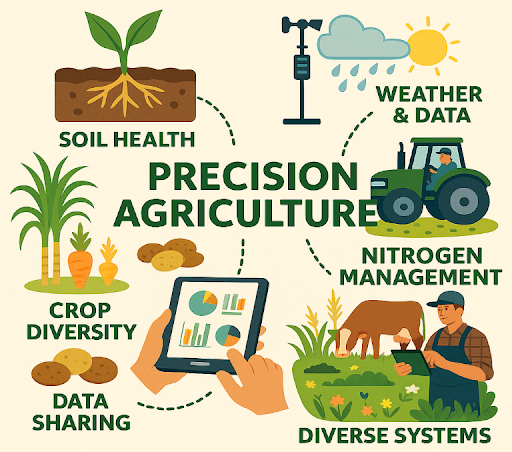
Figure 1. Integrating cover crops, animal integration, soil health, nitrogen management, crop diversity and data-driven tools for profitable and sustainable farming
The 2025 Profit with Precision Workshop, in Miramichi, New Brunswick (N.B.), brought together scientists, agronomists and growers to explore how data and management innovations can increase farm profitability while cutting greenhouse gas emissions (GHGs). Participants agreed on one message: Precision farming isn’t just about technology – it’s about understanding the land, using the right information and linking every management choice to both profit and environmental performance.
Across the sessions, presenters shared results from years of research and on-farm testing. Together, their work painted a picture of how the future of farming in Atlantic Canada can be both data-driven and regenerative – balancing productivity, soil health and accountability.
Seeing Beneath the Surface – Soil as the Foundation
Soil was the starting point for many discussions. Dr. Brandon Heung from Dalhousie University described how Canada’s top 30 centimetres of soil store more than 80 petagrams of carbon – about 13 per cent of the nation’s total carbon. Protecting and understanding that carbon is central to meeting Canada’s net-zero goals. To do that, we need accurate, high-resolution and accessible soil data.
Dr. Heung’s team is building the Canadian Digital Soil Data Portal, a national repository that will merge soil information from provinces, universities and farms into one user-friendly platform. Using soil spectroscopy, they can now analyze samples for about eight dollars each – far less than the 40 dollars traditional lab methods cost. This approach allows frequent sampling and makes it possible to model soil organic carbon and fertility across entire landscapes.
Your own farm soil data could connect directly to this system. Participation from growers helps fill data gaps and ensures that regional soil diversity is represented. Several speakers echoed the importance of keeping physical soil samples. As technology evolves, those archived samples could be re-analyzed with new sensors, saving the time and cost of re-sampling. QR-coded sample bags could make this process even more efficient.
Weather, Data and Disease
Sheldon Hann with Agriculture and Agri-Food Canada (AAFC) advocated that precision management depends on good weather data. With more than 200 weather stations now active across N.B., operated by the New Brunswick Soil and Crop Improvement Association (NBSCIA), the provincial Department of Agriculture and the Living Lab network, real-time weather and soil data are transforming how disease risks are predicted.
AAFC’s predictive weather maps utilize RADAR-derived and High Resolution Deterministic Prediction System (HRDPS) atmospheric elements validated with the network of available weather stations to assist in forecasting late blight and Fusarium head blight. The maps integrate rainfall, humidity and soil temperature data using the ESRI ArcGIS platform. However, data quality and sharing remain challenges – calibration, storage and network compatibility are constant hurdles. The goal is to integrate all geospatial and sensor data into real-time, high-resolution forecasting tools.
Nitrogen – The Double-Edged Sword
No topic drew more attention than nitrogen (N). As Dr. David Burton from Dalhousie University explained, the goal is not to maximize yield, but to maximize profit. Every extra kilogram of N that doesn’t increase yield eats into margins and releases more nitrous oxide, a GHG 300 times stronger than carbon dioxide.
Many fields already receive significant N credits: around 50 to 80 kg N/ha from legumes; 30 to 60 kg N/ha from manure; and 100 to 180 kg N/ha through soil mineralization. Recognizing these natural contributions and adjusting fertilizer rates accordingly allows growers to follow the 4R principles – right rate, source, time and place. Trials in Prince Edward Island (P.E.I.) showed that fine-tuning N management can reduce N₂O emissions by up to 60 per cent while maintaining yields.
Learning from the Field – Precision in Action
Steve Watts from Genesis Crop Systems shared over a decade of results from several multiyear P.E.I. trials including the 4R Nutrient Stewardship Initiative, Dalhousie University Nitrogen Response project and, more recently, the first round of the AAFC Living Labs project. All of these projects were efforts from research teams, that included at times, of Genesis, P.E.I. Department of Agriculture, several P.E.I. watershed groups, Dalhousie University, Cavendish Farms and AAFC. In the first round, the traditional practice – applying all N at planting – was proven inefficient because potatoes cannot use all that N early in the season. The result: excess canopy growth, delayed tuber initiation and lower quality.
Subsequent field-scale trials with split N applications and enhanced-efficiency products such as Super U and ESN showed equal or improved yields in 92 per cent of cases and about 20 per cent lower residual soil nitrate. Later studies found that reducing total N by 15 to 20 per cent from conventional grower standard practices maintained yields while cutting emissions by 60 per cent. New trials with N-fixing products such as Envita and Utrisha N are underway in Living Labs V2 to evaluate their potential role in improving N efficiency and reducing fertilizer needs, though results so far have been variable across sites and years.
Understanding GHGs and Whole-Farm Modeling
Cedric MacLeod and Shelly Juurlink from Living Lab New Brunswick (LLNB) demonstrated how dairy farms are quantifying GHGs using HOLOS and the Cool Farm Tool. These models calculate emissions from feed, livestock and energy use. Dr. Roland Kröbel of AAFC explained that HOLOS integrates crop, manure and soil data into a single digital model, allowing users to compare management scenarios. The model remains confidential to the user and helps growers identify where they can improve efficiency and reduce emissions.
Research from the University of Guelph – Nitrogen and Crop Diversity
Dr. Claudia Wagner-Riddle’s team’s long-term work at the University of Guelph in Ontario (presented at the meeting by Dr. Agustin Olivo) showed that perennial forages (alfalfa–grass) emit markedly less N₂O than annual crops such as corn, and that injecting manure into perennials increased yield without raising emissions. In corn systems, adding nitrification/urease inhibitors reduced total N₂O emissions in most years tested while maintaining yield.
In a later rotation study, a diverse rotation showed lower emissions in the winter-wheat years, and higher N₂O emissions in certain years with cover crops (compared to no cover crop use). However, across a multi-year window, using N inhibitors during the corn year lowered cumulative emissions from the diverse rotation. Overall, targeting “hot moments” of N2O emissions (wet soils with high mineral N) and pairing crop diversification with well-timed urease and nitrification inhibitor use mitigated N₂O while sustaining productivity.
The Data Behind It All – Governance and Trust
Donna Curtis Maillet, privacy officer DataNB and research associate Faculty of Law at the University of New Brunswick, highlighted that as agriculture becomes more digital, data governance is becoming essential. Effective governance defines who collects data, who can access it and how it is shared. She introduced the Five Safes Framework – Safe Data, Safe Projects, Safe People, Safe Spaces and Safe Outputs – to ensure responsible data use. For growers, this means their farm information remains private and secure while still supporting innovation and collaboration.
Bringing It All Together
The workshop reinforced that profitable, sustainable farming depends on integration – linking soil data, weather forecasting, N management, GHG modeling and responsible data sharing into one practical system. High-resolution soil maps and weather-based forecasts now help identify where and when nutrients are needed most, while improved N practices such as split applications, inhibitors and recognition of natural soil and manure credits reduce both costs and emissions. Long-term trials show that diversified rotations and perennial systems build soil health and lower nitrous oxide losses and farm-scale models like HOLOS demonstrate how management changes translate into measurable emission reductions.
Building on these insights, participants highlighted the growing need for a national soil and data infrastructure to support precision agriculture. Initiatives such as the Canadian Digital Soil Data Portal and the National Soil Data Inventory aim to integrate spectroscopy-based soil analyses, georeferenced sampling and standardized metadata into user-friendly platforms accessible to researchers and producers.
These systems, coupled with libraries of archived soil samples and pedotransfer models, will allow future reanalysis and improve soil health prediction. Advances in artificial intelligence and cloud-based tools are helping manage and compress large datasets, while clear data governance frameworks ensure grower privacy and interoperability across platforms.
At the same time, collaboration between universities, industry and government is advancing the integration of weather, N and GHG data into digital tools. The continued development of Holos Version 5, its API link with AgExpert, and high-resolution disease forecasting maps demonstrate how digital systems can support both productivity and emission reduction. Training growers in farm data management platforms such as AgExpert enables them to maintain accurate records of rotations, inputs, yields and soil test data – creating a long-term database for continuous improvement, traceability and benchmarking.
Together, these developments lay the foundation for a coordinated, national approach to precision agriculture – one that connects scientific research, digital innovation and on-farm practices. By combining strong data governance, advanced modeling and collaborative engagement, Canada is positioning itself as a leader in data-driven, climate-smart agriculture where environmental stewardship and profitability work hand in hand.
Expanding Knowledge: Global and National Strategies to Reduce Nitrous Oxide Emissions
Building on the insights shared at the LLNB Workshop, recent research and national initiatives continue to strengthen the case for better N efficiency. The Produce More, Emit Less webinar (2025) highlighted practical ways growers can reduce nitrous oxide (N₂O) emissions without compromising yields. The speakers emphasized synchronizing N applications with crop demand, using enhanced-efficiency fertilizers (EEFs), integrating cover crops, improving drainage and aeration and adopting weather- and soil moisture-based decision tools to guide fertilizer timing. These strategies work together to minimize N losses, enhance soil health and improve profitability (Produce More, Emit Less webinar, 2025).
According to Environment and Climate Change Canada’s latest National Inventory Report (2024 edition; data for 2022), the agriculture sector accounts for roughly eight to 10 per cent of Canada’s total GHGs, depending on whether on-farm fuel use is included. Nitrous oxide emissions from fertilizers and soils are the largest source, contributing about half of the sector’s total.¹ The U.S. EPA and USDA Climate Hubs report similar trends, emphasizing that improving nitrogen-use efficiency remains one of the most cost-effective strategies to reduce agricultural GHGs.² ³Researchers have also found that current national inventories may underestimate N₂O emissions in cold climates because they often miss the sharp emission “pulses” that occur during soil freezing and thawing events.⁴ In Atlantic Canada’s variable climate, this means growers who improve drainage, avoid soil compaction and fine-tune fertilizer timing can achieve both environmental and economic benefits.
The Canadian Nitrous Oxide Network (CanN₂ONet) project, led by the University of Guelph and national partners, is advancing regionally adapted solutions to help Canada meet its 2030 GHG-reduction targets.⁵ ⁶ This initiative, along with AAFC’s research and international collaboration, highlights how combining on-farm data, soil models like HOLOS and grower participation can accelerate progress toward climate-smart agriculture. For producers, the message is clear: efficient N management and soil stewardship are not only good for the environment – they’re central to long-term profitability, resilience and leadership in sustainable food production.
Breeders are also contributing to emission reduction by developing potato varieties that use N more efficiently. In P.E.I. and across Canada, efforts are underway to gradually shift from older cultivars such as Russet Burbank toward newer, shorter-season varieties that require less N. Many of these newer varieties need up to 15 per cent less N than Russet Burbank to achieve optimum yield and quality. This highlights an important message for growers: Not all potato varieties have the same N needs and applying more N does not necessarily increase yield. In fact, excess N can delay tuber initiation and maturity, reduce tuber quality and lower overall productivity. Continued breeding progress, combined with effective knowledge transfer to growers, will help ensure that N rates are matched to variety needs and growing conditions – supporting both profitability and environmental sustainability.
In N.B., many growers have begun adopting more diverse rotations and cover crops, signaling a positive shift toward more resilient farming systems. There is a growing need to conduct additional on-farm trials with new varieties, regenerative practices and emerging technologies to better understand what works under local conditions. While regenerative practices show great promise, they are still in the learning stage and every season provides new insights. Continued knowledge sharing, collaboration and field demonstrations will be key to helping growers strengthen resilience and thrive in both dry and wet seasons. To accelerate adoption, growers also need continued support through programs such as the On-Farm Climate Action Fund (OFCAF) and similar initiatives that provide financial assistance, technical guidance and incentives to implement sustainable practices and measure their long-term impact.
Conclusion – Precision with Purpose
The Profit with Precision Workshop and ongoing global and national strategies to reduce nitrous oxide made it clear that profitability and sustainability are not opposing goals – they are two sides of the same coin. Across all discussions, one message stood out: using data wisely, understanding soils and matching inputs to crop needs leads to stronger profits and lower emissions. Precision agriculture today is not about complex technology – it’s about making informed, evidence-based decisions. Splitting N applications, recognizing natural nutrient credits and using EEFs are simple yet powerful steps that pay off in yield, soil health and resilience.
Growers who document their practices and share information through trusted networks like LLNB will gain both agronomic and economic advantages. These practices position them to benefit from future sustainability programs that reward verified improvements in soil health and carbon efficiency.
The future of Atlantic agriculture lies in collaboration – where science, technology and grower knowledge come together to produce more with less, protect the environment and ensure long-term profitability for the next generation. Every pass of the tractor, every soil test and every management choice matters. Precision, in the end, means farming with purpose and leaving the land stronger than we found it.
References
Agriculture and Agri-Food Canada. Greenhouse Gas Emissions and Agriculture. https://agriculture.canada.ca/en/environment/greenhouse-gases
U.S. Environmental Protection Agency. Nitrous Oxide Emissions. https://www.epa.gov/ghgemissions/nitrous-oxide-emissions
U.S. Department of Agriculture Climate Hubs. Cost-Effective Strategies to Reduce Agricultural Greenhouse Gases. https://www.climatehubs.usda.gov/hubs/northeast/topic/cost-effective-strategies-reduce-agricultural-greenhouse-gases
Del Grosso et al. “A gap in nitrous oxide emission reporting complicates long-term climate mitigation.” PNAS (2022). https://doi.org/10.1073/pnas.2200354119
University of Guelph News (2024). U of G researcher leads national effort to reduce nitrous oxide, a major source of Canada’s emissions. https://news.uoguelph.ca/2024/08/u-of-g-researcher-leads-national-effort-to-reduce-nitrous-oxide-major-source-of-canadas-emissions/
Sustainable Soils Initiative. CanN₂ONet: A Canadian Nitrous Oxide Collaboration Network to Meet Greenhouse Gas Reduction Targets. https://www.sustainablesoils.ca/project/cann2onet-a-canadian-nitrous-oxide-collaboration-network-to-meet-greenhouse-gas-emission-reduction-targets
Additional Resource
Produce More, Emit Less webinar, 2025. YouTube video. https://youtu.be/z5Ej7r7B4bI
Living Lab New Brunswick uses a unique approach to agricultural innovation in Canada, bringing together farmers, scientists and other partners to co-develop and test innovative farming practices in real-world conditions. It is part of a nationwide network of living labs under the Agricultural Climate Solutions – Living Labs program, funded and supported by Agriculture and Agri-Food Canada. Each project aims to accelerate the development and adoption of sustainable on-farm solutions to address climate change.
Compiled and prepared by Dr. Manphool Fageria, PhD, PAg
manphoolfageriaregensolutions.com
Based on presentations and recordings from the Living Lab NB (LLNB) Workshop – Profit with Precision: Insights from the 2025 Workshop on Nitrogen, Soil and Data-Driven Farming (Miramichi, N.B.) – and supported by recent national and global research highlighting advances in N efficiency.